Melissodes baileyi
Scientific Classification
Kingdom
Phylum
Class
Order
Family
Tribe
Genus
Subgenus
Species
Binomial Name
Melissodes baileyi
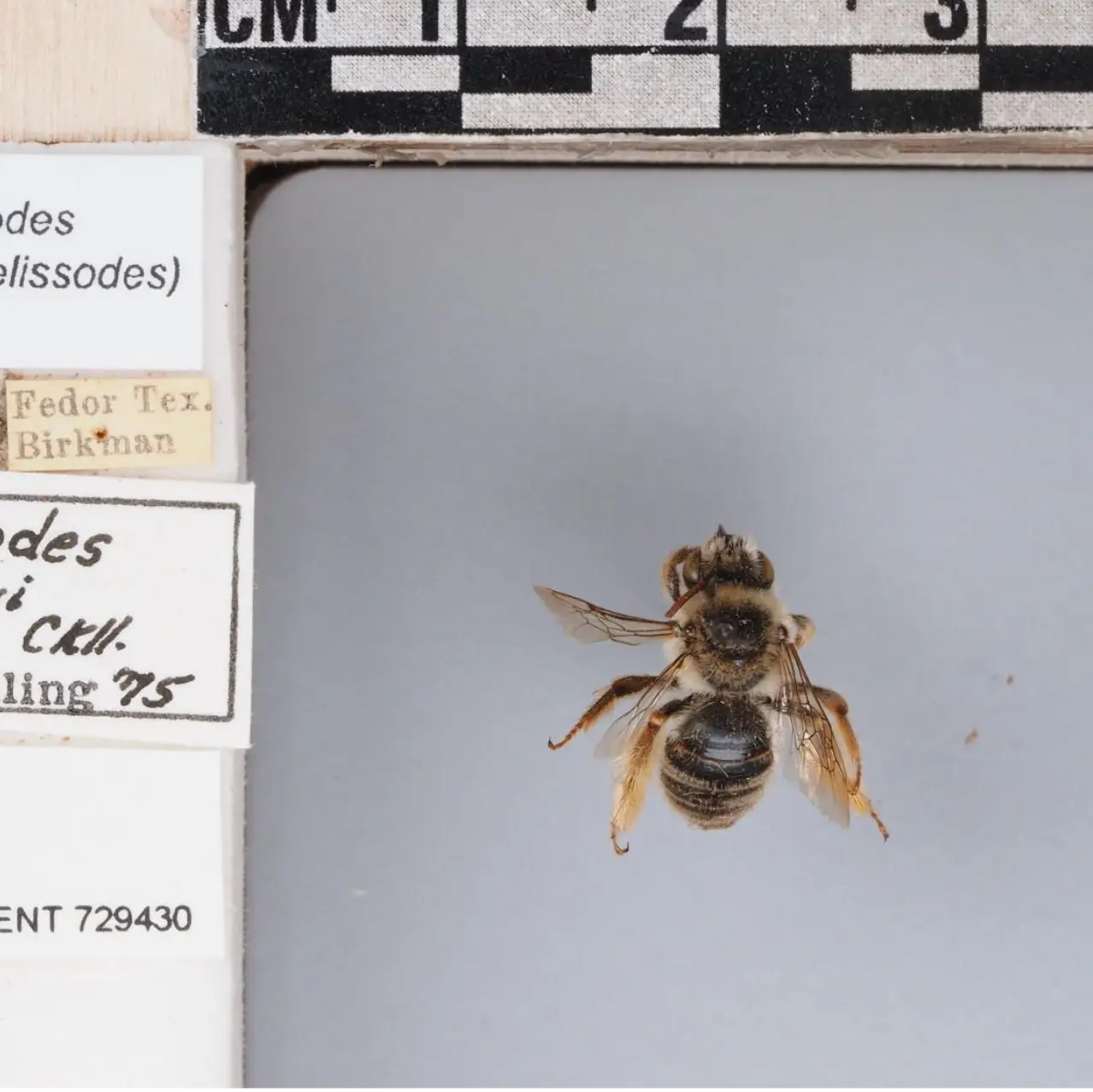
Melissodes baileyi Cockerell is a rare and extremely localized species of Nearctic bee (Laberge, 1956a). Like all Melissodes, male M. baileyi have long antennae, and the females have short antennae in comparison (see "Genus" page for more information). This species resides in the subgenus M. (Apomelissodes) Laberge, although some male traits don’t completely agree with this subgeneric classification (see “Taxonomy and Phylogeny” for more information). Females bear a resemblance to M. fimbriata and sometimes M. apicatus, but can be distinguished from the former by the short galea as well as the relatively flat clypeus. M. baileyi can also be easily distinguished from the latter by the lack of abundant, long, hooked, galeal hairs (Laberge, 1956a). Males are interesting as they were described seven years after Laberge’s (1956a) female treatment, and there seems to be somewhat weak connections delimiting the described males as M. baileyi (see “Taxonomy and Phylogeny” for more information) (Laberge, 1956a; Laberge, 1963). Males can be distinguished from other M. (Apomelissodes) by the weaker vestiture, relatively short antennae, and a somewhat rounded upper head margin when looking in facial view (Laberge, 1963). M. baileyi has only two flower records, one of which is expectedly Asteracea, however the other belongs to Malvaceae (Laberge, 1963). As there isn’t enough available data, a definitive answer cannot be justified as to the flower preferences and/or oligolecty of M. baileyi.
Description and Identification
Based on Laberge's (1956a; 1963) descriptions, Melissodes baileyi are medium sized setaceous bees (only one female and two males have been examined, and therefore, female measurements and ratios have no current range, and male ratio and measurement ranges are derived from two specimens). Females are 11 millimeters in length and 4 millimeters in width (width measured at the widest portion of the metasoma). Males are a bit smaller, being about 10 to 11 millimeters in length and 3.5 to 4.0 millimeters in width (width measured at the widest portion of the metasoma). The female's first flagellar segment is 1.97 times the size of the second flagellar segment. The males are the opposite where the second flagellar segment is on average 5.13 to 5.38 times the size of the first flagellar segment. Female wing length is 3.33 millimeters on average, and male wing length is 3.57 to 3.67 millimeters. Females have 13 hamuli, while males also have 13.
Female
According to Laberge (1956a), the description of female M. baileyi is as follows: the integument is black, differing at the eyes, which are gray; the the mandibles, which are, in the apical three-fourths, dark reddish brown and they have a large golden medial macula in the apical half; the wing membranes, which are colorless hyaline; the wing veins, which are dark brown; the underside of flagellar segments 3-10, which are red; the apical margin of the first tergum, which is colorless hyaline; the tegulae, which are piceous; and the legs and sterna, which are dark reddish brown. The clypeus is moderately shiny and has dense, round, regularly sized punctures that are separated by one-half to one puncture diameter. The supraclypeal area is shiny, coarsely punctate laterally, and impunctate medially. The portion of the flattened area of the vertex positioned posteromedially from the apices of the compound eyes is shiny and has irregularly sized, abundant, round punctures that are mostly separated by less than, or equal to, one puncture width. The galeae are shiny, either with no shagreening dorsally or very faint shagreening, and have sparse punctures and sparse straight short hairs. The galea also measure to be approximately twice the length of the medial clypeal length. The four maxillary palpal segments decrease in length from basal to distal in a ratio of about 2.5:2:2:1. The mesoscutum is shiny with no shagreening and has small round punctures that are separated in the anterior half by half a puncture diameter, in the periphery by half a puncture diameter, and posteromedially by one puncture width or slightly more. The scutellum is shiny with no shagreening and has small punctures, similar in size to that of the nearby mesoscutal punctures, that are separated medially by one-half to one puncture diameter, and separated peripherally by slightly less. The mesepisterna are shiny with no shagreening and have large shallow punctures (several punctures weakly defined postoventrally), that are separated by less than, or equal to, one-half of a puncture diameter. The metanotum is dull laterally, shiny medially, and has abundant small punctures that are sparse laterally and dense medially. These punctures are approximately half the size of the posterior scutellar punctures. The dorsal surface of the propodeum is dull due to dense fine tessellation, reticulorugose excluding the medial area, and has a few large posterior punctures. The posterior surface of the propodeum is dull due to dense tessellation and has dense punctures excluding the upper impunctate triangle.
The first tergum is moderately shiny due to coarse, dense, transverse, shagreening and has punctures in the basal one-half. These punctures are separated in the median half apically by one to two puncture diameters. In the basal portion as well as the lateral areas where the punctures reach the apex, these punctures are separated by less than, or equal to, half a puncture diameter. The second tergum is matte as well as dull due to fine transverse shagreening and has a densely punctate basal area, an impuncate apical area, and an interband zone that is almost medially impunctate, but has lateral punctures that are separated by less than, or equal to, one puncture diameter. Terga three and four are similar to that of the second tergum, except the interband zones have denser punctures.
Because its original treatment was based on one specimen (Laberge, 1956a), the female will have no setal color ranges in this description. The head hairs are completely white. The entirety of the mesosoma bears white hairs, except for the mesoscutum, which has a dark brown patch of hairs that reaches the anterior margins of the tegulae, and the scutellum, which has dark hairs on the periphery. The first tergum has long white hairs in the basal one-half, and these hairs are long enough to reach the apex of the tergum laterally. The second tergum’s basal band is white and connects to the distal apical band laterally with white erect hairs. The interband zone of the second tergum is approximately the same width of the distal apical band and bears simple, short, dark brown, bristle-like, hairs. The distal apical band of the second tergum has short-branched, long, white, pubescence; this band reaches the apex across the entire tergum. The third and fourth terga are similar to that of the second, but the hairs of the basal bands are instead dark brown. The fifth and sixth terga are covered in long dark-brown hairs, and the former has long white lateral tufts of hair. The sterna have reddish brown medial hairs, and white hairs apicolaterally; these white hairs are present on every sterna excluding the first and last. The hairs of the leg are white except for the outer surfaces of the fore tarsi, which are brown; the distal areas of the fore tibiae and middle tibiae, which are brown; the basal area of the hind tibiae, which are brown; the middle basitarsi, hind basitarsi, and hind tibiae, which are yellowish orange; and the scopal hairs, which are pale yellow to white, and unbranched.
Male
According to Laberge (1963), the description of male M. baileyi is as follows: the integument is black, differing at the eyes, which are green; the clypeus, which besides the brown apical margin; the labrum, which has a white mediobasal maculation approximately one-third of the size of the labrum; the wing membranes, which are slightly infumate with yellow colorations; the wing veins which are dark reddish brown; flagellar segments 2-11, which, on the underside are red to yellow and on top are brown; the apices of the terga, which are hyaline and slightly infumate; the tibial spurs, which are hyaline; and the tarsi, which are rufescent. The head is rounded when looking in facial view with the area between the compound eye and ocelli sloping upward towards the ocelli. The antennae are somewhat short compared to other male Melissodes, when put in repose, they do not reach the prestigma. The length of the penultimate flagellar segment is less than three times its width, and the length of the ultimate segment is approximately three times its width at the base. The four maxillary palpal segments decrease in length from basal to distal in a ratio of about 2.5:2:2:1. The sculpture characteristics are similar to that of the female except for the interband zones of the terga, which have sparser punctures that are mostly separated by more than, or equal to, one puncture diameter. The pygidial plate has deep lateral notches, although the apical portion and the basal portion are not elevated above one another. The sterna are remarkably shiny with no shagreening and have sparse coarse punctures.
In his M. baileyi description, Laberge (1963) wrote a comparative treatment of the male terminalia, comparing it to M. fimbriata. However, the only terminalia descriptions for male M. fimbriata are those of figures 111-113 from Laberge (1956b). Herein, the male terminalia for M. baileyi will be based on figures 111-113 (M. fimbriata) from Laberge (1956b), with the exceptions listed by Laberge (1963). The seventh sternum narrows into a short distinct neck for roughly one-fifth or less the length of the entire sternum, then in the apical one-fifth to one-fourth, widens and becomes captate. This neck region has long and somewhat stout hairs, and so does the base of the neck. There are a few hairs ventrally on the apical one-fifth of the seventh sternum. The 8th sternum usually has a few hairs apically (less hairs on the apical margin, but hairs that are present on the apical margin tend to be longer), and the apicoventral tubercle is somewhat blunt-ended. The gonostylus is broad with a few hairs dorsolaterally, is less than two-thirds the length of the gonocoxite, and isn't capitate. The penis valve doesn’t have a prominent dorsolateral lamella, but rather a low protuberance.
The setal description is as follows: the head hairs are white to pale ochraceous, but if pale ochraceous, then it’s faintly so. The thoracic hairs are mostly white on the lower surfaces (i.e. lower portions of the mesepisterna and ventral areas), and somewhat more pale ochraceous on the upper areas. The mesoscutum has long, sparse, brown, weak hairs on the posteromedial area, and the scutellum has these same hairs medially. The first tergum has white to pale ochraceous, long, erect to suberect, weak hairs that almost reach the apical margin. The tomentum at the base of the second tergum is white and sparse. The interband zone of the second tergum has sparse, long, white, suberect hairs. The distal pale band of the second tergum has weak, long, white, pubescence; this band reaches the apex across the entire tergum or almost does. The third, fourth, and fifth terga share the same characteristics as the second. The sixth and seventh terga are entirely covered in white pubescence. The sterna have sparse hairs that are medially brown, and apically as well as laterally, the hairs are white. The legs have white hairs excluding the yellow to orange inner surfaces of the tarsi.
Location and Habitat
M. baileyi is a rare and incredibly localized species of Nearctic bee, seemingly only found in Texas (Laberge, 1963; Laberge, 1956a). In his treatment, Laberge (1956a) examined only 1 female specimen, that being the holotype, which was collected in Fedor, Lee County, Texas on 1904-04-05. Another female collected on 1903-04-6, the oldest known specimen of female M. baileyi to date, was found in Taylor, Texas (Laberge, 1963). Two specimens, designated to be the males of M. baileyi, were also collected in Texas. The first male collected on 1953-04-14 in Lexington, Texas and the second male on 1953-04-17 in Harper, Texas (Laberge, 1963). Only three of the eight publicly accessible M. baileyi records contain geodata associated with them (GBIF Secretariat, 2023), and although it’s known that the range of M. baileyi extends further west to Taylor, Texas (Laberge, 1963), this datapoint has been omitted from the map shown below due to missing coordinates (see Fig. 1). There are currently no published phenological activity patterns in regards to M. baileyi likely due to the very few documented occurrences. Interestingly, all collections of M. baileyi starting from its first collection to the current day last collection (1903-1953), have occurred in April (Fig. 2) (Laberge, 1956a; Laberge, 1963; GBIF Secretariat, 2023). However, more documentations of this species are necessary to make a definitive statement about phenological activity.
Fig. 1. Map showing an estimation for the known distribution for M. (Apomelissodes) baileyi. Each point represents 1 or more occurrences; occurrences that don't have coordinates are not included. Data compiled from GBIF (Secretariat 2023).
Bionomics
Currently, nothing ecxept genus-level inferences can be made regarding the nesting biology and behaviors of M. baileyi.
Flower records
All flower records included in this list are from reports in the literature. Each flower has a parenthesized reference listed after it, corresponding to the literary work in which it was recorded. Callirhoe sp. (Laberge, 1963), Gaillardia suavis (Laberge, 1963).
Taxonomy and Phylogeny
M. baileyi was originally described in 1906 by Theodore Dru Alison Cockerell from the female holotype (Laberge, 1956a) (sadly, this original description couldn’t be found). As no subgenera had been proposed during its first description, M. baileyi was given no subgenus. However, during his second revision, Laberge (1956a) assigned M. baileyi to M. (Apomelissodes) Laberge due to the simple non-branched scopal hairs, the apically positioned tergal bands, the slightly protuberant clypeus, and the striking resemblance to M. fimbriata (Laberge, 1956a; Laberge, 1963). Interestingly, at the time of Laberge’s (1956a) second revision, male’s of M. baileyi had yet to be discovered. One year after this publication, two males, collected in 1953, were subsequently described by Laberge in his 1963 paper. In this treatment, Laberge (1963) noted that these male specimens, when using Laberge’s (1956 & 1961) subgeneric keys, keyed out to M. (Eumelissodes) Laberge instead of the expected M. (Apomelissodes) Laberge. The males do however seem to fit into M. (Apomelissodes) Laberge based on terminalia structure, underdeveloped M. (Apomelissodes) Laberge features, and the sharing of female sculptural patterns (Laberge, 1963). They were also strictly collected in Texas as well as during the same months in which the females were collected. This, along with the characters listed above, shows high likelihood of the male specimens being placed correctly (Laberge, 1963), however, DNA testing would be beneficial in determining the taxonomic validity.
References
1. LaBerge, W.E. (1956a) ‘A revision of the bees of the genus melissodes in north and
Central America. part II (hymenoptera, Apidae)’, The University of Kansas science
bulletin, 38(8), pp. 533–578. doi:10.5962/p.376392.
2. LaBerge, Wallace E. (1963), "New Species and Records of Little-known Species of Melissodes from North America (Hymenoptera:
Anthophoridae)". Bulletin of the University of Nebraska State Museum. 9.
http://digitalcommons.unl.edu/museumbulletin/9
3. GBIF.org (29 November 2025) GBIF Occurrence Download, DOI available at time of access: https://doi.org/10.15468/dl.bm3vdr.
Archive preserved at Zenodo: https://doi.org/10.5281/zenodo.17764810
4. LaBerge, W.E. (1956b) ‘A revision of the bees of the genus melissodes in north and Central America. part I.
(Hymenoptera, Apidae)’, The University of Kansas science bulletin, 37(18), pp. 911–1194. doi:10.5962/bhl.part.24549.