Melissodes appressus
Scientific Classification
Kingdom
Phylum
Class
Order
Family
Tribe
Genus
Subgenus
Species
Binomial Name
Melissodes appressus
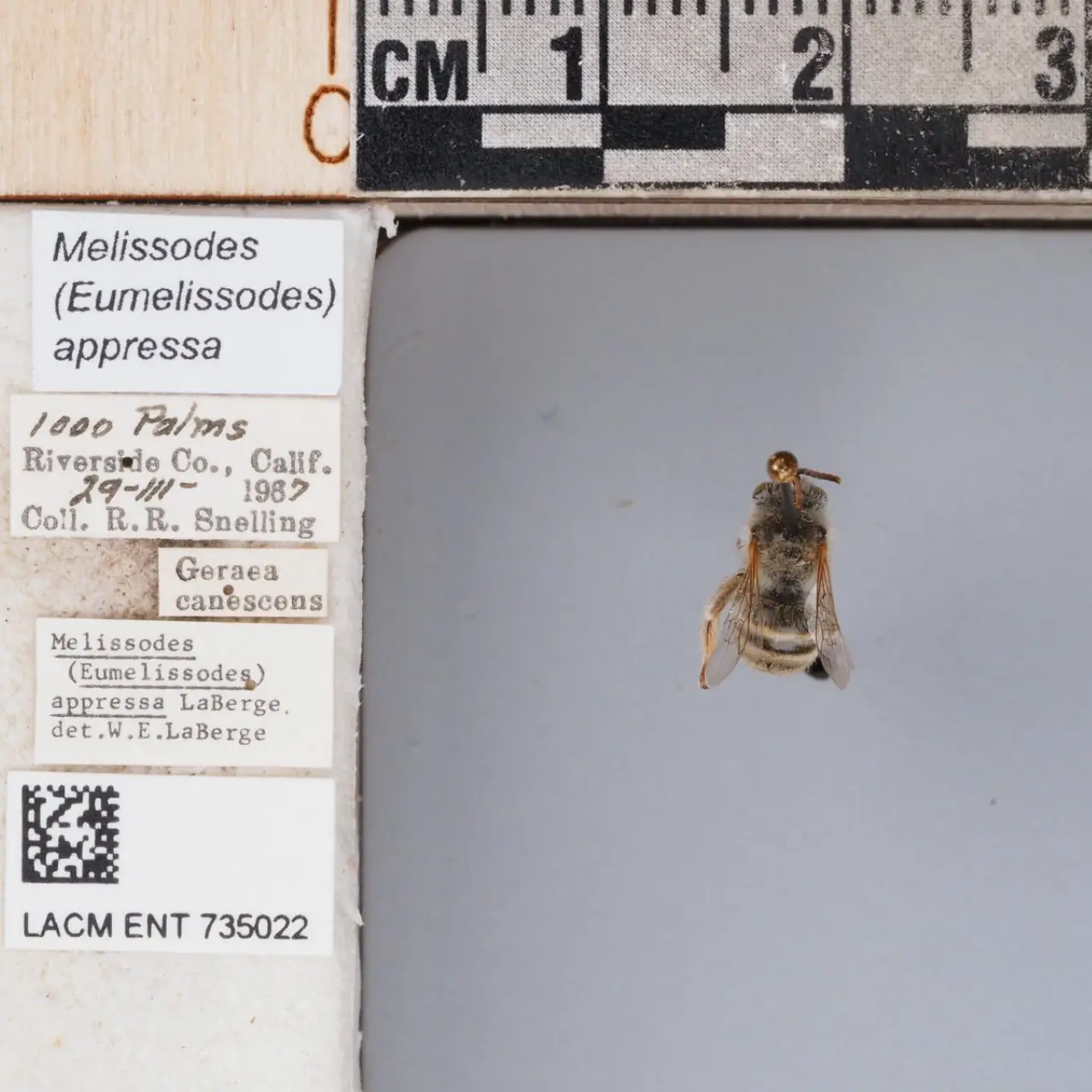
Melissodes appressus Laberge is a somewhat rare and geographically limited species of Nearctic bee (Laberge, 1961). Like all Melissodes, male M. appressus have long antennae, and the females have short antennae in comparison (see "Genus" page for more information). This species resides in the subgenus M. (Eumelissodes) Laberge. Both sexes of M. appressus are somewhat distinct from other M. (Eumelissodes) Laberge, but bears a resemblance to M. subagilis. Females can be distinguished by the distal white to pale ochraceous band of the second tergum at minimum reaching the apical margin laterally and usually reaches the apex across the entire tergum, consisting of short broad hairs (at maximum each hair twice as long as wide; treated more thoroughly in “Description and Identification”), the blunt, short, decumbent mesoscutal hairs, shiny galea, and the inner surfaces of the hind bastitarsi which bare brownish red hairs (Laberge, 1961). Males can be distinguished from that of other M. (Eumelissodes) Laberge by their shiny galea (except at tips), yellow clypeus except for dark tentorial depressions and a testaceous apical margin, and entirely black labrum (see “Description and Identification” for more information on both sexes) (Laberge, 1961). M. apressus is an oligolege of the family Asteracea (as are almost all Melissodes), and seems to prefer three genera specifically, Isocoma, Guterrezia, and Heterotheca (Laberge, 1961). Although not a generalist in the truest sense, M. appressus has been collected on 10 other genera of Asteracea, and three other families. However, the three other families on which it was collected seem to have been visited strictly by males, which just collect nectar, not pollen. So it’s safe to assume that M. appressus may be polylectic on Asteracea.
Description and Identification
Based on Laberge's (1961) description, Melissodes appressus are medium sized setaceous bees (somewhat smaller bees within the genus). Females range from 10 to 12 millimeters in length and 3 to 4 millimeters in width (width measured at the widest portion of the metasoma). Males are a bit smaller, being about 8 to 11 millimeters in length and 2.5 to 3.0 millimeters in width (width measured at the widest portion of the metasoma). The female's first flagellar segment is on average 1.98 times the size of the second flagellar segment (standard error 0.017). The males are the opposite where the second flagellar segment is on average 5.86 times the size of the first flagellar segment (standard error 0.145). Female wing length is 2.67 millimeters on average (standard error 0.153 millimeters), and male wing length is 2.56 millimeters on average (standard error 0.144 millimeters). Females have an average of 12.45 hamuli (standard error 0.153; ranging between 12 and 13), while males have an average of 11.40 (standard error 0.152; ranging between 11 and 12).
Female
According to Laberge (1961), the description of female M. appressus is as follows: the integument is black, differing at the eyes, which are often blue, but sometimes they’re gray or greenish blue; the mandibles, which are usually rufescent the wing membranes, which are colorless hyaline; the wing veins, which are usually dark reddish brown; the underside of flagellar segments 3-10, and usually the second in the apical one-third, which are red to yellow (dark brown on top); the tegulae, which are piceous; the tarsi, and sometimes the rest of the legs, which are rufescent; the tibial spurs, which are white to yellow; and the apices of the terga (likely referring only the first tergum, but possibly all), which is/are faintly rufescent, less than in M. subagilis; The clypeus is shiny, flat without a large bulge or concavity, and has a weak apicomedian carina. The punctures of the clypeus are round, large, coarse, and mostly separated by half a puncture diameter or less. The oculoclypeal distance is less than or equal to half of the first flagellar segment’s minimum width. The supraclypeal area is entirely shiny and unshagreened, or if shagreened, then very finely. The length of the third flagellar segment is approximately equal to the maximum width (sometimes more, sometimes less). The galeae are dorsally shiny with no shagreening, excluding the apical one-third, and sometimes less. The lateral areas of the vertex are shiny and have punctures that are mostly separated by two to three puncture diameters. The four maxillary palpal segments decrease in length from basal to apical in a ratio of about 2.7:2.0:1.7:1.0. The mesoscutum is shiny and has deep, large, round punctures that are separated by one-half to one puncture diameter on the periphery. Posteromedially, these punctures are large and separated by one to two puncture diameters, and usually there is a small impunctate posteromedial area. The scutellum is similar to that of the mesoscutum, but the punctures tend to be denser. The mesepisterna are shiny and have deep, large punctures that are separated by one-half or less of a puncture diameter.
The first tergum is shiny and the basal three-fifths has shallow, round punctures that are separated by one-half to one puncture in diameter. The apical area of the first tergum is impunctate with no anterolaterally indistinct rounded projections on each side of the tergum. The basal area of the second tergum is shiny, sometimes finely reticularly shagreened, with punctures that are mostly separated by one puncture diameter. The interband zone of the second tergum has regular, sparse, punctures that are slightly larger than that of the basal area and mostly separated by more than, or equal to, one puncture diameter. The apical area of the second tergum usually isn’t present, but when visible, it’s mostly impunctate except for a few small punctures beneath the distal band’s pubescence. Terga three and four are similar to that of tergum two, but the apical area is usually absent (likely obscured by pubescent band), and the interband zones have more crowded punctures. The pygidial plate is longer than it is wide basally, “V” shaped, and rounded at the apex.
Setal description is as follows: the head hairs are white to pale ochraceous, except for the vertex which has abundant brown hairs. The hairs of the mesoscutum are decumbent on the anterior most one-third and have a blunt-like appearance, similar to that of cut hair. These hairs are pale ochraceous to yellowish, except for the posteromedial dark patch of brown hairs which is usually equal to, or more than, twice the size of the dark patch on the scutellum. The mesopleural hairs are white to pale ochraceous. The first tergum has basal white to pale ochraceous hairs that reach the apical margin laterally, and is glabrous apicomedially. The basal white tomentum of the second tergum laterally connects with the white to pale ochraceous distal pale band. The distal band of the second tergum consists of short broad appressed pubescence (at maximum each hair twice as long as wide) that, in the band’s apical half, tend not to, or just slightly, overlap each other (notably towards the middle). This band reaches the apical margin at minimum laterally, but usually reaches the apex across most of the tergum. Sometimes along the apex of the distal band, notably towards the middle, there’s some brown pubescence. The apical area of the second tergum, if present, tends to be somewhat bare. If the apical area isn’t bare, then it usually has one to two irregular rows of simple, appressed to subappressed, short, brown hairs. The third tergum is like that of the second, but the tomentum on the basal area is brown, the apical area is often “absent” (likely obscured by pubescent band), but if present, then it’s no wider than one-third of the third tergum’s width, and the pubescence of the distal band is longer. The fourth tergum is similar to that of the third, but the apical area is never present. The fifth and sixth terga have dark brown hairs across the terga, but laterally, there’s white tufts of hair. The sterna have medial yellow hairs, white apical hairs, and white lateral hairs besides the last sternum, which seems to have entirely yellow hairs. The legs have white to pale ochraceous hairs except for the outer surfaces of the fore tibiae and middle tibiae, which are brown; the inner surfaces of the hind basitarsi, which are red to dark reddish brown; and the scopal hairs, which are white.
Male
According to Laberge (1961), the description of male M. appressus is as follows: the integument is black, differing at the eyes, which are often blue to greenish blue, and sometimes they can be gray to yellowish gray; the clypeus, which is yellow besides for the darkened tentorial depressions and the testaceous apical margin; the wing membranes, which are colorless hyaline; the wing veins, which are reddish brown to red; the tegulae, which are usually piceous, although sometimes somewhat testaceous dorsally; the tarsi, and sometimes the rest of the legs, which are rufescent; the tibial spurs, which are white to yellow; and the terga, which are colorless hyaline in the apical areas. The clypeus is flat without a large bulge or concavity. The oculoclypeal distance is less than or equal to half of the first flagellar segment’s minimum width. The first flagellar segment’s minimum length is usually equivalent to one-seventh to one-eighth the second segment’s maximum length, and on rare occasions it can be as short at one-tenth the maximum length of the second segment. The minimum length of the first flagellar segment (smaller side of F1) is often more than half the maximum length (longer side of F1). The length of the penultimate flagellar segment is longer than three times its width. The flagellum reaches or slightly surpasses the pterostigma when in repose. The maxillary palpal segments decrease in length from basal to apical in a ratio of about 3.0:2.5:2.0:1.0. The oblique subapical carinae of the sixth sternum is faint. The remainder of the sculptural characteristics are the same as the female described above except as follows: The mesoscutum tends to be punctate entirely with no posteromedian impunctate area; the first tergum has punctures that almost reach the apical margin; terga two, three, and four’s interband zone punctures are separated by one to two punctures in diameter (in general, sparser than that of the female), and the apical areas are often absent (likely obscured by pubescent bands).
The 7th sternum’s median plate is subtriangular, larger than the lateral plate, and has abundant short hairs ventrally. The lateral plate of the 7th sternum is also subtriangular. The membranous area between the plates is narrow and almost half the size of the lateral plate. The apicomedial margin located between the median plates has strongly curved carinae on each side. The 8th sternum is broad near the apex, has several to many hairs on the apical margin, distinctly emarginate apicomedially, and the ventral tubercle is entirely to slightly bidentate. The ventral tubercle does not reach the apical margin of the 8th sternum. The Gonostylus is slender, tapers apically, has abundant short hairs on the basal half laterally, and isn’t distinctly capitate. The length of the gonostylus is longer than half the length of the gonocoxite. The spatha is about three times as wide as it is long. The spicules of the upper inner surface of the gonocoxite are all if not mostly hairlike. The penis valve has a prominent dorsolateral lamella; the basal end of the lamella ends in an inflected tooth near the spatha.
Setal description is as follows: the head hairs are entirely white. The hairs of the mesoscutum are decumbent on the apical most one-third and differ from the female by not having blunt-tipped hairs. These hairs are white and sometimes pale ochraceous. The mesopleural hairs are white. The first tergum has pale ochraceous hairs that, in the apical most one-fifth to one-fourth, are appressed and form a band that obscures the apical margin. The basal tomentum of the second tergum is white as well as the distal pale band. This band reaches the apical margin laterally, but sometimes reaches the apex across the entire tergum. The interband zone of the second tergum has suberect to erect, long, pale hairs. The apical area of the second tergum, if present, is glabrous, usually half the length of the distal pale band medially (measured from basal to apical area of pale band), and less than or equal to half the width of the tergum. Terga three, four, and five are similar to that of two, but the distal bands are positioned apically obscuring the apical area, except for the third tergum which sometimes has a small apical glabrous area. The sixth and seventh terga have entirely ochraceous to white hairs. All sterna are white laterally and yellow medially. The leg hairs are white excluding the yellow inner surfaces of the tarsi.
Location and Habitat
M. appressus is a somewhat rare, and geographically limited species of Nearctic bee (Laberge, 1961). In his treatment, Laberge (1961), noted that this species has only been found in California. However, newer collections (1961-1985) suggest that M. appressus also occurs in Utah, New Mexico, and Arizona showing that the range of this species is broader than what has been represented in the historical literature (GBIF Secretariat, 2023). One datapoint from GBIF (Secretariat, 2023) located in Zacatecas, Mexico has been omitted in the map shown below as this seems to be an outlier and may not properly reflect M. appressus’ range (Fig. 1). The only phenological activity currently published for M. appressus states that the species has been documented to be active from August 14 to November 10 although peak activity during collection periods seemed to occur in September to October (Laberge, 1961). Newer data seems to reflect this statement, except for one specimen collected in May (see Fig. 2) (Bentley & Osborn, 2025)
Fig. 1. Map showing an estimation for the known distribution for M. (Eumelissodes) appressus. Each point represents 1 or more occurrences; occurrences that don't have coordinates are not included. Data compiled from GBIF (Secretariat 2023).
Fig. 2. A figure showing the phenological activity of M. appressus. The x value is the month, and the y value is the number of documented observations. Data compiled from and GBIF (Secretariat 2023).
Bionomics
Currently, nothing ecxept genus-level inferences can be made regarding the nesting biology and behaviors of M. appressus.
Flower records
All flower records included in this list are from reports in the literature. Each flower has a parenthesized reference listed after it, corresponding to the literary work in which it was recorded. Aster sp. (Laberge, 1961), Centromadia pungens (Laberge, 1961), Croton californicus (Laberge, 1961), Ericameria palmeri (Laberge, 1961), Euthamia occidentalis (Laberge, 1961), Grindelia sp. (Laberge, 1961; originally presented as “Grindelia californica”, however, this name cannot be found to be a valid or synonymous name in any taxonomic databases), Gutierrezia californica (Laberge, 1961), Gutierrezia microcephala (Laberge, 1961), Gutierrezia sarothrae (Laberge, 1961), Helianthus annuus (Laberge, 1961), Heliotropium curassavicum var. oculatum (Laberge, 1961), Heterotheca grandiflora (Laberge, 1961), Isocoma acradenia (Laberge, 1961), Isocoma menziesii var. vernonioides (Laberge, 1961), Lessingia glandulifera (Laberge, 1961), Lobularia maritima (Laberge, 1961), Melilotus officinalis (Laberge, 1961), Pluchea camphorata (Laberge, 1961), Senecio sp. (Laberge, 1961), Solidago sp. (Laberge, 1961; originally presented as “Solidago anfinis”, however, this name cannot be found to be a valid or synonymous name in any taxonomic databases), Symphyotrichum expansum (Laberge, 1961).
Taxonomy and Phylogeny
M. appressus was originally described in 1961 by Wallace Laberge under the name “Melissodes appressa”. When first described, M. appressus was assigned to the subgenus M. (Eumelissodes), which is also where it currently resides (Laberge, 1961). Little taxonomic reclassification has occurred concerning M. appressus. Currently, the only taxonomic changes arose when the fourth edition of the International Commission on Zoological Nomenclature (ICZN) was released in 1999, and article 30.1.4.4 was added. This article stated if a genus with the suffix -odes (i.e. Melissodes) was not assigned a specific gender by the author who proposed it, then the genus becomes masculine. When Melissodes was proposed in 1829 by Latreille, he included no statements deeming the name “Melissodes” to be feminine or masculine, therefore, the genus became masculine. According to ICZN, species and genus names must make gender agreement. Because the suffix -a (i.e. appressa) is feminine and the genus name is now masculine, the species name also had to be updated with a masculine suffix; the suffix -us is masculine hence “appressus” instead of “appressa”. There have since been no taxonomic changes in regards to M. appressus.
References
1. GBIF.org (24 November 2025) GBIF Occurrence Download, DOI available at time of access: https://doi.org/10.15468/dl.mqr3nm.
Archive preserved at Zenodo: https://doi.org/10.5281/zenodo.17705791
2. International Commission on Zoological Nomenclature (ICZN). 1999. International Code of Zoological Nomenclature (Online). Edited by Ride, W.D.L.,
Cogger, H.G., Dupuis, C., Kraus, O., Minelli, A., Thompson, F.C. & Tubbs, P.K. International Commission on Zoological Nomenclature.
Available at: https://code.iczn.org/ (Accessed: 20 November 2025)
3. LaBerge, W.E. (1961) ‘A revision of the bees of the genus melissodes in north and Central America.
part III (hymenoptera, Apidae)’, The University of Kansas science bulletin, 42(5), pp. 283–663.
doi:10.5962/bhl.part.9821.
4. Bentley A, Osborn R (2025). Snow Entomological Museum Collection. University of Kansas Biodiversity Institute. Occurrence dataset https://doi.org/10.15468/fhntpy accessed via GBIF.org on 2025-11-28. https://www.gbif.org/occurrence/1092837916